A pointed chin does not settle the heart vs diamond face question. Both descriptions can include a narrow lower face; the useful difference is usually higher up, around the forehead and cheekbones. I find the comparison easier when it starts with an ordinary front view and a few visible landmarks, rather than a diagram that expects every outline to fit perfectly. Check which area is widest, notice where the sides narrow, and keep room for a mixed description. The result should help you try a haircut or a pair of glasses, without turning a small styling decision into a test you have to pass.
Show your forehead before judging its width
Move fringe away from your face and tuck loose pieces behind your ears. Use clips lightly: pulling the hair tightly back can change the apparent corners of the hairline and make the forehead look more exposed than it normally does. A headband can help, but place it behind the hairline rather than over it. You need to see the upper outline, including the temples, without pressing the skin or flattening everything into an unfamiliar shape.
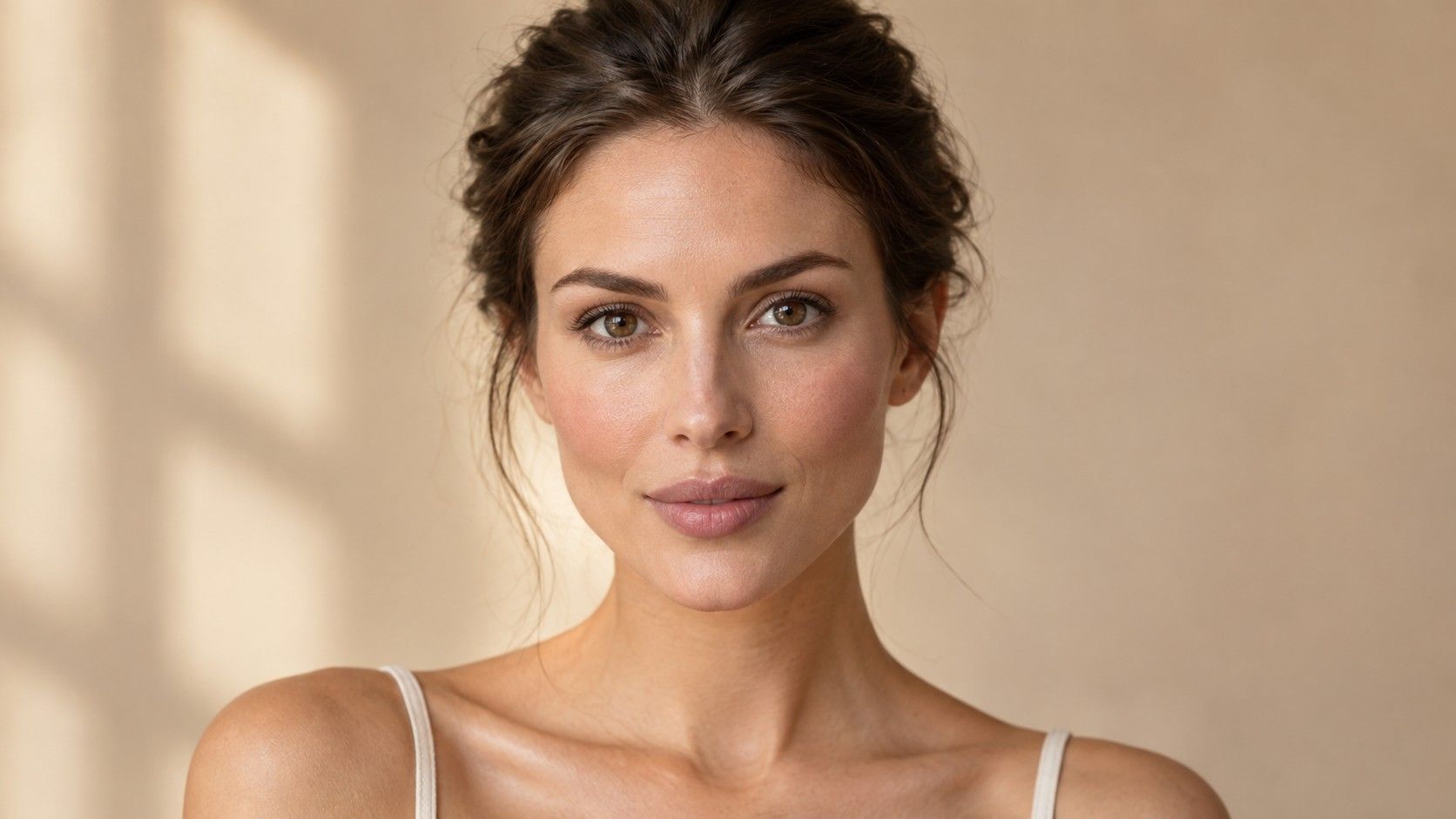
Stand facing a mirror with your head level, jaw relaxed and lips resting naturally. Light from a window in front of you makes the outline easier to follow than a ceiling light that casts dark patches at the temples. If you use a photograph, keep the camera near eye level and avoid a close wide-angle selfie. Step back and crop the image afterwards. The aim is a usable comparison, not a photograph in which your forehead happens to look especially broad.
A widow's peak is a hairline detail, not a requirement for a heart-shaped face. A central point can make the familiar heart diagram look convincing while the side-to-side width tells a different story. Receding corners, a side part and fine baby hairs can also alter your impression. Compare the visible forehead span and the cheekbone area before naming the shape from the top edge alone.
Find the widest zone without chasing tiny differences
Look across the upper cheekbones, roughly beneath the outer parts of the eyes, and then across the forehead above the eyebrows. For a heart description, the forehead or upper face is often broad relative to the jaw, with a taper toward the chin. For a diamond description, the cheekbones are the clearest wide point, while both the forehead and jaw appear narrower. These are descriptive conventions; there is no agreed numerical margin that makes one label compulsory.
It can help to draw short horizontal lines on a copy of a front-facing photograph. Keep the forehead line at a consistent height instead of moving it until it produces your preferred result. Mark the widest visible cheekbone span, then compare both with the jaw. Do not include ears or the outer edge of your hair. If the two upper widths look almost equal, write down “broad upper face, narrow chin” and leave the fine distinction open.
A soft tape measure can provide a second reference, but surface measurements curve around the face. They will not match straight lines drawn on a photograph. Use one method consistently and treat small differences cautiously. A second neutral picture on another day is often more informative than repeatedly measuring the same uncertain landmark to the nearest millimetre.
Follow the taper toward the chin
Now trace the outline from the cheekbones down to the jaw corners and chin. Both heart and diamond descriptions can have a pronounced taper, so this step confirms the lower-face pattern rather than deciding everything by itself. Notice whether the jaw narrows gradually, whether the chin is rounded or pointed, and whether one side seems broader because your head is slightly turned. Ordinary asymmetry does not invalidate the comparison.
A heart outline may look fuller across the forehead and narrower through the lower cheeks. A diamond outline often has a more obvious change in direction around the cheekbones, narrowing above and below that point. Real faces rarely draw those lines as neatly as a printed icon. Cheek fullness, facial hair and expression can soften the boundary. Avoid clenching your teeth or pursing your lips to make the jaw look more angular for the photograph.
Write a description you could actually use in a shop: “cheekbones widest, narrow temples, tapered jaw” is more useful than “definitely diamond” if you are choosing frames. If the forehead remains broad while your cheekbones also stand out, heart–diamond is a reasonable shorthand. You can choose styling based on individual features even when the overall label stays uncertain.
Choose glasses by temple fit and cheek clearance
Start by checking where the frame touches you. The bridge should sit securely without pinching, and the arms should reach the ears comfortably without pushing hard against the temples. Smile while wearing the glasses: if the lower rims rise with your cheeks, compare another frame size or bridge design. A frame recommended for a diamond face can still be uncomfortable on your particular nose and cheekbones.
For a face with prominent cheekbones and narrower temples, try a frame whose upper edge has some visual presence. A gentle upsweep or a rounded rectangular shape may place attention nearer the brow. Compare it with a lighter, quieter frame in the same size. The purpose is to see what expression you prefer; your cheekbones do not need disguising, and a bold frame is a perfectly valid choice when you enjoy it.
If your forehead is the broader area, compare a slim upper rim with a stronger one before assuming one is forbidden. A pale acetate frame, a thin metal frame and a dark full rim can look quite different despite sharing the same outline. Take front and three-quarter photographs in similar light. Check the view with your everyday hairstyle, since a pushed-back try-on picture may reveal much more forehead than your usual appearance does.
Test hair placement around the cheeks and temples
Before booking a cut, use clips to move your existing hair into two or three arrangements. For a narrow forehead with wider cheekbones, try a little movement near the temples and compare it with a very flat top and sides. For a broad forehead with a tapered jaw, try loose pieces near the lower cheeks or jaw. These are experiments in where the hair adds visual width, not corrections that everyone with the same face label needs.
A fringe can change the visible forehead substantially. Ask where it will sit when dry, how it separates with your natural part and whether you will actually style it each morning. A dense straight fringe may create a strong horizontal edge; a lighter curtain shape can reveal more of the forehead through the centre. Hair texture, density and growth direction affect the result as much as the face outline. Bring a photograph of your own hair on an ordinary day alongside any reference cut.
Length is less useful as a rule than the position of the bulk. Two shoulder-length cuts can put volume in very different places, especially with curls or waves. Look at where the widest part of the hairstyle lands relative to your cheekbones. If you like your cheekbones as the focal point, leaving that area open may be exactly right. If you want a softer outline, test movement beside it and notice whether you like the extra maintenance.
Keep the description that makes choices easier
Finish with a short note: widest area, forehead visibility, jaw taper and any fit problem you actually encounter. That gives you a repeatable starting point when shopping or discussing a haircut. Save one neutral picture, then stop checking if additional photos are producing the same broad answer. Different charts and face-shape tools may choose different labels for an outline that sits between their categories.
The practical decision can be much smaller than the classification question. You might prefer frames with a little brow emphasis, or hair that leaves the cheekbones visible. Neither choice requires a definitive heart or diamond result. Wear the glasses for a few minutes, move naturally, and judge the hairstyle with the amount of effort you are willing to give it. Comfort and a look you recognise as your own provide a better stopping point than a perfect match to a diagram.