Bangs change the visible outline of your forehead, but the cut has to work with the hair growing above it. A broad forehead does not require a heavy fringe, and a round face does not rule out a blunt edge. Start with the amount of coverage you enjoy, then check the roots, density, and daily styling. That sequence makes a salon reference much easier to turn into a cut you will actually want to maintain.
Decide what you want to see around your forehead
Before choosing a named style, decide how much forehead you want visible. Full coverage creates a different outline from a centre opening or a few loose pieces. None is automatically more flattering. You might want a strong horizontal line, a soft frame around the eyes, or hair that moves away from your face when you work. Those are clearer starting points than a face category alone.
Look in the mirror with your hair in its usual position, then loosely hold a few front sections where a fringe might sit. This is only a sketch: folded lengths are often heavier and behave differently from freshly cut bangs. Still, it can help you notice whether you enjoy a central opening, a longer side piece, or a line near the eyebrows. Take a photo to show the idea rather than expecting it to predict the finished cut.
Forehead height is one part of the choice. Also notice where the eyebrows, glasses, and front hairline sit in relation to the proposed fringe. If you wear large frames, try the temporary shape with them on. A fringe that looks right without glasses may crowd the upper frame when you put them back. Your stylist can help judge the interaction using the way you normally present yourself.
Watch the roots before choosing the finished edge
A cowlick can make a carefully drawn fringe open, lift, or change direction. Check the front roots after a normal wash and dry, before strong styling holds them in place. Notice where the hair naturally parts and whether one side lifts more than the other. Do not fight it into symmetry for the consultation photograph; the natural pattern is useful information for the person doing the cut.
Tell the stylist how you usually dry your hair. Someone who uses a dryer every morning has different options from someone who washes at night and leaves it to settle. A reference picture may show a fringe that has been blow-dried into place. Ask what the same cut is likely to do when you follow your own routine. The answer may suggest a longer version, a different opening, or a fringe that works with the natural direction.
Curly and wavy hair needs a conversation about its dry behaviour too. Bring examples of your own hair on an ordinary day and mention how it changes with humidity or the time since washing. The finished length should be discussed in the state you intend to wear it. Avoid copying a wet length from a video or making a major first cut at home based on a straight-haired reference.
Match the amount of fringe to the hair you have
A dense, full fringe uses more hair than a light, separated one. Pulling a large section forward for an imitation can borrow volume from the sides that you may want to keep. Ask the stylist to show the section they propose before cutting. You can then discuss how much hair remains around the temples and whether the overall haircut still has the shape you like.
Fine strands and low density are different descriptions, so explain what you actually notice. Does the front separate into gaps? Does it feel heavy against the forehead? Does a thicker section lie flatter than you expected? Concrete observations help more than calling your hair “bad for bangs.” A lighter fringe can look deliberately airy, while a fuller one may be possible with a different section or styling approach. The decision needs to be made on your own hair.
Product habits matter as well. If you dislike the feel of styling products near your forehead, say so before agreeing to a look maintained with daily product. If you often tuck the front behind your ears, decide whether the new length will still allow that. A style that suits a static outline can become annoying if it removes the small habits that make your hair easy to live with.
| Preference or constraint | Option to discuss | Question for the stylist |
|---|---|---|
| You like an open centre | Curtain fringe | Will my roots separate in this direction? |
| You want a defined front line | Blunt fringe | How will the line sit when my hair dries naturally? |
| You often move hair away from one side | Side-swept fringe | Which direction works with my growth pattern? |
| You want easy ways to pin it back | A longer starting version | What will still tuck or clip away? |
Compare curtain and blunt shapes without a rulebook
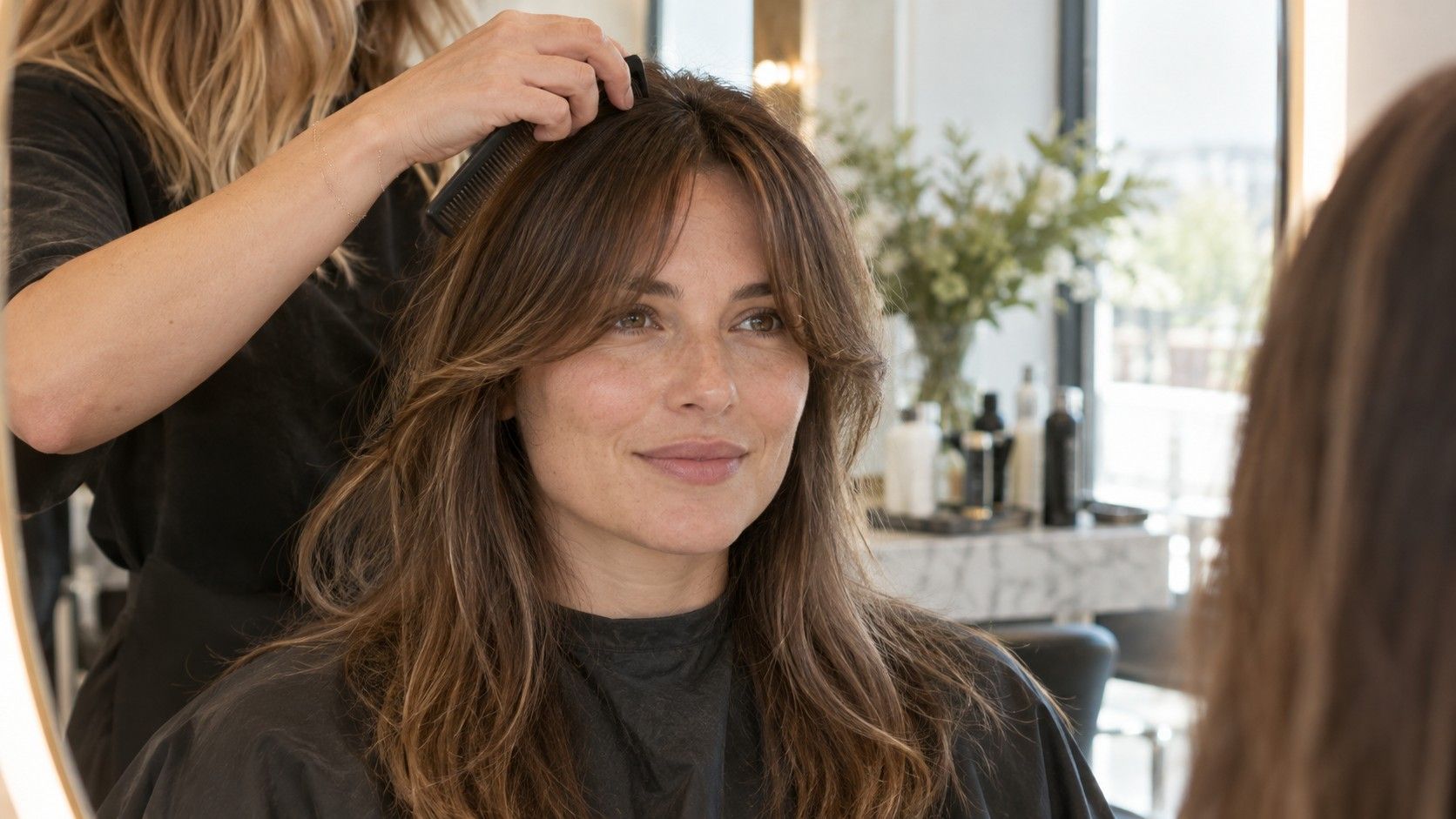
Curtain bangs usually leave an opening and become longer toward the sides. That can frame the central face while keeping some forehead visible. The effect depends on where the opening begins, how the ends sit, and whether the hair actually sweeps away. Two photographs labelled curtain bangs may show quite different cuts. Point to the parts you like instead of relying on the label to communicate everything.
A blunt fringe creates a more continuous edge. Its width and weight affect the impression as much as its length does. A narrow section can leave more visible space at the temples; a broader section makes a stronger line across the front. Ask to see where the proposed edge will begin and end. You can prefer that graphic effect on a curved face, an angular face, or an outline that mixes both.
People searching for bangs for face shape are often trying to make a long face look shorter or a broad forehead look less prominent. Those are optional visual goals, not requirements. If that is your preference, discuss the coverage and side volume that create the effect you want. If you enjoy showing your forehead or repeating a strong horizontal line, say that instead. A good consultation needs your intention, not an assumed correction.
Bring two or three references with hair texture close to yours, including one that shows the side view. Explain which detail matters: the opening, the length at the cheek, or the density across the centre. A stylist may suggest borrowing one detail from each rather than copying a complete image. That gives you a specific conversation even if you have never settled on a face shape label.
Agree on the morning routine before the scissors come out
Ask the stylist to demonstrate how the fringe will be dried and arranged. Watch the direction of airflow, the tools used, and how much time the process takes. Then say whether that fits your mornings. A routine that feels reasonable in a salon chair can be less appealing when you are leaving early, travelling light, or trying to avoid heat styling. Adjust the plan while there is still room to choose.
Discuss trims and the grow-out stage. A shorter fringe can start falling into the eyes as it grows, while a longer opening may need restyling sooner than you expect. Ask how often this particular cut will need attention and whether fringe trims are available. Do not rely on a universal timetable; your starting length, growth, and tolerance for change all affect the answer.
Think through a windy walk, a workout, a hat, and a day when you do not wash your hair. You do not need a fringe that stays identical in all those situations. You do need a workable way to handle it: a clip, a change of part, a quick restyle, or simply allowing it to move. If keeping it out of your face is a priority, make that a requirement of the consultation.
Starting longer can leave more room to adjust during the appointment, though it will not reproduce every shorter style. Ask the stylist which parts can be refined once you have seen the dry result. Leave with a plan you understand and a fringe you are willing to maintain. The most useful choice combines the coverage you enjoy with the way your hair grows, rather than asking a shape chart to make the decision for you.