One face shape app says oval, another says heart, and a third returns several percentages. That disagreement can come from the photographs, the category definitions, or the way each service produces its output. It does not mean you need to find a hidden, perfectly precise label. Start by checking what the tools actually saw and what their results claim to mean, then make a simple manual comparison before uploading more photographs.
Check whether you gave the tools the same view
Put the two reference images beside each other before comparing the labels. Was one a close selfie and the other taken from farther away? Is your chin lower in one? Does a fringe hide the hairline, or a beard cover the jaw corners? Those differences can change the outline available to judge. A result cannot be interpreted sensibly if the input itself keeps changing.
For a cleaner comparison, use one unfiltered, straight-on photograph with an ordinary relaxed expression. Keep the camera near face height and move it far enough away to avoid the exaggerated perspective of a very close selfie. Use even light so one side does not disappear into shadow. If you take another photograph, keep the setup similar rather than hunting for an angle that returns your preferred label.
Look at the image crop too. A crop that removes the top of the head may make the hairline difficult to locate; a tight edge beside the jaw can conceal where the face ends. Cropping away background is different from stretching a photograph. If width and height have been resized by different amounts, the proportions have changed. Return to an original file whose shape has been preserved.
Check any instructions the service provides about hair, glasses, expression, or camera position. Follow them only if you are comfortable doing so. If it shows the landmarks it used, see whether they correspond to the visible face. An obvious point on hair instead of skin is a reason to question that particular result. If no landmarks are shown, avoid assuming that the outline was identified correctly.
Find out what the category names actually mean
Shape names sound consistent until you compare the diagrams. One chart may use oblong and rectangular separately; another may group them. Heart and inverted triangle may be described with overlapping features. If two services offer different label sets, their answers cannot be compared as though they came from one shared test. A missing category may lead to a different available description.
Read any explanation that comes with the label. Does “oval” mean a softly curved outline that is longer than wide, or is the definition left unstated? Does “square” refer mainly to jaw corners or to similar widths across several levels? The explanation is often more useful than the name. If there is no definition, treat the label as a suggestion for comparison rather than a settled measurement.
A face may also share features with several diagrams. Broad cheekbones and a gently rounded jaw can pull a description in different directions depending on which feature gets more emphasis. You can record both without deciding that one tool must have discovered the truth. “Cheekbones widest, soft jaw, moderate length” remains understandable even when the category names disagree.
This is why a vote among apps has limits. Three labels do not become an independent measurement just because they match. You may not know whether the services use similar methods or similar category definitions. Agreement can give you a starting point to examine, but the visible features and the decision you want to make still deserve their own check.
Read percentages as unexplained until the method is clear
A result such as “oval 70%” can look like a probability that your face is objectively oval. It may mean something else within that tool. Unless the service explains the score, you cannot tell whether it represents a similarity measure, a model output, or another calculation. Do not convert the number into a claim that the tool is 70% accurate or that your face has a measurable oval percentage.
To assess a claim about the accuracy of a face shape detector, look for an explanation of what was evaluated, how the reference labels were chosen, and which conditions were included. A large-sounding number without that context cannot tell you how reliable a result is for your photograph. Even a described evaluation needs to be relevant to the question you are asking. Do not invent a validation standard to fill a gap in the service's documentation.
There is also a difference between a stable output and a correct description. A tool may return the same label repeatedly for one image. That tells you something about that particular repeated check, but it does not prove agreement with a reliable external reference. Conversely, a changing result is a reason to be cautious, not proof that a specific competing tool is accurate.
Keep a simple distinction in your notes: a score describes the tool's output, while an accuracy claim needs evidence about the evaluation. If several labels are close together, preserve that mixed description. There is no need to keep uploading until one category appears to win.
Make one manual check that produces a useful sentence
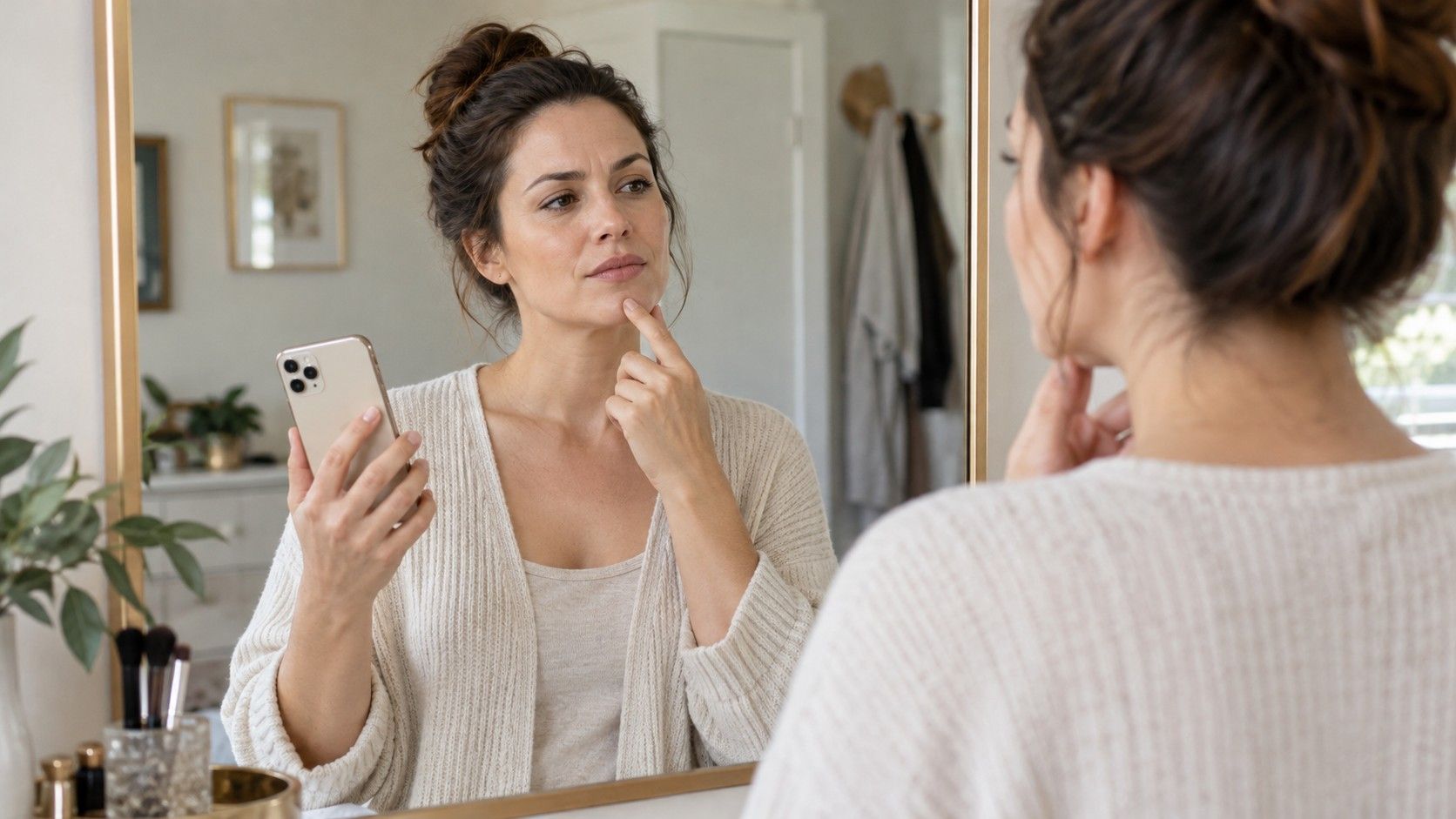
Move away from the score and look in a mirror. Keep hair clear of the temples and jaw, relax your mouth, and compare forehead, cheekbone, and jaw width. Which area looks broadest? Then consider overall length and whether the jaw has a distinct corner, a gentle curve, or a taper. You do not need a complete set of measurements to notice these broad relationships.
If you use measurements, keep the landmarks and method consistent. A tape following the surface over the nose measures a different path from a straight visible width in a photograph. Do not combine those numbers as though they were interchangeable. When two widths are too close to distinguish confidently, call them similar. That is more honest and more useful than forcing the order a calculator demands.
Write the observation in plain language: “Forehead and cheekbones similar, jaw narrows, chin softly pointed.” Now compare the app's description with that sentence. Perhaps its heart label explains the taper while another app's oval label reflects the softer edges. You can use the feature description without choosing a winner. The point is to understand your outline well enough to test a styling idea.
For glasses, try comfortable frames and compare the visual effect after an optician checks the fit. For hair, discuss the area where you want more or less volume along with texture and daily upkeep. Neither task requires a pure category. If an app recommendation conflicts with a pair that fits comfortably or a haircut you enjoy maintaining, the recommendation has not earned the right to overrule that experience.
Review the upload decision before sending another photo
When the results disagree, it is tempting to try a succession of new services. Pause long enough to read the information available before each upload. Check what the service says about processing, photo storage, sharing, and deletion. If those points are unclear, you can choose a mirror check instead. You do not need to submit an image to another site merely to resolve a minor styling question.
Be precise about what you know. A page saying that an image is deleted does not, by itself, let you personally verify how deletion happens. A claim about local processing should be read in the context of the service's actual explanation rather than inferred from a fast response or a browser interface. Avoid assuming that all tools work the same way, whether the assumption is reassuring or worrying.
Use your own photograph if you decide to proceed, and keep unrelated people or private background details out of it. Consider whether an account or extra personal information is necessary for the result you want. You can decline a request you do not understand. That is a practical choice about an optional service, not a reason to keep searching until a tool offers a more confident label.
A reasonable stopping point is one clear reference view, a manual feature description, and perhaps a tool result you can interpret. Save your observation rather than a growing collection of conflicting scores. Face shape apps can prompt a useful comparison, but their disagreement does not create a problem with your face. It leaves you with a rough description to test against real preferences, comfort, and the way you want to wear your hair or accessories.