A long earring can look delicate beside one hairstyle and surprisingly prominent beside another. That difference is often more useful than a rule assigning drops to one face shape and hoops to another. When choosing earrings for face shape, compare where the piece ends, how much space it occupies and how it feels when you move. Your outline can suggest a trial, but the earrings still have to work with your ears, hair, neckline and ordinary day.
Choose the effect you want before opening a shape chart
Stand at a mirror far enough away to see your head and shoulders together. Decide whether you want the earrings to be a small detail, a clear outline beside the face, or the main focus of the outfit. A broad, bright piece can draw attention even when it is short. A long fine chain may take up more length while remaining visually quiet. The category on the packet does not tell the whole story.
Look at your face without trying to correct it. You may have a curved lower outline, noticeable jaw corners, broad cheeks or a comparatively long face. These features can help you describe the relationship you enjoy. Hoops can repeat curves; geometric drops can echo angles. Contrast is another option. There is no obligation to choose the opposite shape every time you put on jewellery.
Keep one familiar outfit on while comparing pairs. A high collar, dark neckline or busy print changes how easily an earring stands out. If every trial uses a different top and hairstyle, it becomes hard to know what you preferred about the jewellery itself. I would start with a plain top, then check the favourite pair with the clothing it is actually meant to accompany.
Compare drop length beside the jaw, then turn your head
The useful measurement for a drop is the distance from its attachment to its lowest point as worn. Product descriptions may use total length or describe only a decorative component, so check the diagram where one is provided. Two earrings with equal listed lengths can hang differently if one uses a stud fitting and the other begins with a hook. Your piercing position also affects where the bottom falls.
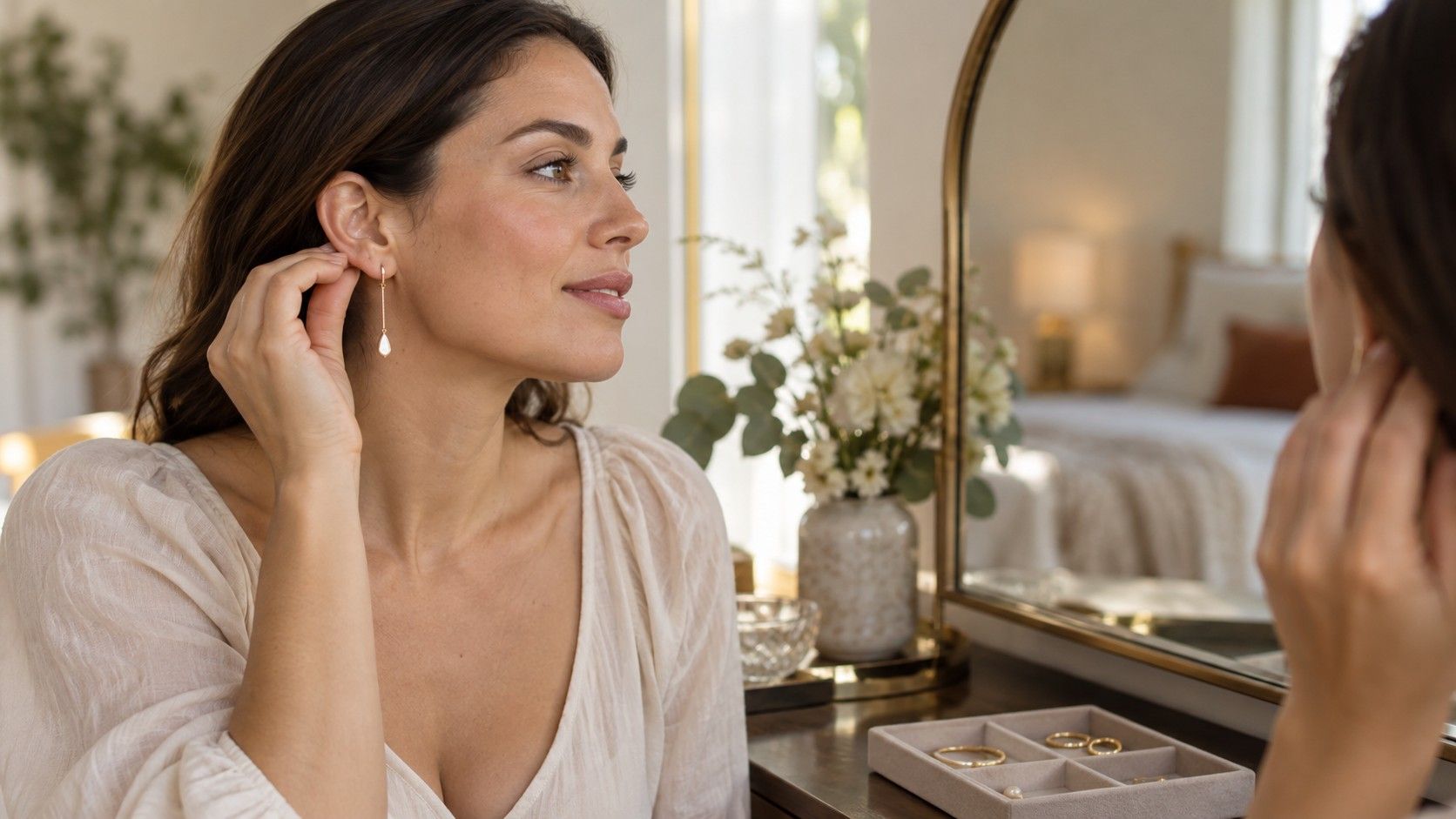
Try one pair ending above the jaw and another reaching toward or below it. Look straight ahead, then turn to a three-quarter view. Notice whether you like the endpoint beside your cheek, jaw corner or neck. A wider ornament at the bottom creates a different effect from a thin line of the same length. Treat the endpoint as something to observe rather than a border you must avoid crossing.
If you enjoy a longer outline, a narrow drop can be a deliberate choice on a long face. If you want more visible width beside a narrow lower face, a broader drop may provide it. Neither experiment needs to be described as balancing a flaw. The useful question is whether you like the relationship between the earring, the visible jaw and the space above your shoulder.
Check clearance with a natural turn of the head. A long piece can touch a collar or shoulder before it looks especially long from the front. Sit down as well as standing: shoulders and necklines shift when you work or travel. An earring chosen for dinner needs a different clearance check from one intended for a day in a high-neck sweater.
Judge hoops by diameter, thickness and viewing angle
A large thin hoop and a small thick hoop can have very different visual weight. Diameter describes the size of the loop, while thickness influences how substantial the metal looks. Finish matters too: a bright polished surface catches light differently from a matte one. Compare these features separately where you can, instead of assuming that all hoops create the same rounded effect.
Look from the side as well as the front. Some hoops sit nearly edge-on in a straight-on photograph, then become much more visible when you turn. Others are shaped or positioned to show more of their circle from the front. The hinge, post and placement on your ear affect the result. A product image floating against white cannot show precisely how the pair will sit on you.
Try the hoops with your hair down and tucked behind the ears. A fine loop may disappear into textured hair, while a broad surface remains visible. If you want a subtle pair, that may be ideal. If you bought earrings to be a focal point, check them from across the room before deciding. Visibility and size are related, but they are not interchangeable.
Let weight and movement decide what is wearable
Visual weight describes how substantial an earring looks. Physical weight describes what your ear carries. A hollow hoop can look bold while feeling comparatively light; a compact solid piece may feel heavier than its size suggests. Read whether a listed weight is for one earring or the pair. If the seller does not specify, do not assume that a photograph supplies the answer.
During a try-on, notice pulling, pressure from the backing and whether the earring sits comfortably on the earlobe. A pair that requires constant repositioning is unlikely to become an easy everyday option. Move your head, look down and make the small motions you make while talking. Dangling parts may swing farther than expected, or make a sound you notice in a quiet room.
If you like a bold pair but feel too much pull, compare a lighter construction with similar dimensions. When drops meet a collar, try a shorter drop with the same width before rejecting the whole design. Fine hoops that disappear into hair may need a more visible surface rather than a larger diameter. These small comparisons preserve the part you enjoyed while addressing the practical problem.
Pay attention to the fitting as well as the decoration. A backing that feels awkward can change how the earring sits even when its outline looks right. Compare a different fitting on a similar design where possible. The aim is to find a pair that stays comfortable during ordinary movement, without constant checking or adjustment.
Follow a shop's hygiene and try-on rules, and use your own jewellery when testing a combination at home. There is no useful universal weight limit that predicts everyone's comfort. If a pair feels uncomfortable, remove it rather than treating discomfort as the price of the desired shape. Buying a visually similar but easier pair is a practical solution.
Check hair, glasses and neckline as one arrangement
Put on your everyday glasses if you wear them. A heavy upper rim and a substantial earring may create the strong combined outline you want, or feel busier than expected. Compare the same earrings with your hair tucked back before changing the jewellery. Sometimes the extra space around the ear makes the arrangement clearer without altering either accessory.
Scarves, collars and loose hair can catch or crowd a drop. A piece that works with an open neckline may become awkward with a winter coat. Try the coat or scarf you expect to wear, and turn your head slowly before leaving home. Think about headphones, phone calls and any equipment you use during the day. A comfortable mirror pose is only the beginning of the test.
For an occasion, rehearse the intended hairstyle early enough to change your mind. An updo reveals more of the ear and neck, which can make familiar earrings look more prominent. Loose waves may partly cover them and create their own movement. A photograph from normal standing distance helps you judge the whole arrangement, but check the physical clearance directly rather than relying on the image.
Keep a small record of what actually works
When a pair becomes a favourite, note its approximate drop, hoop diameter or width, together with the fitting and how it feels. Those details make online comparisons easier. A saved photograph with your normal hair is more informative than a note saying “good for oval faces.” If a new pair disappoints, you can identify whether the issue is length, visibility, movement or comfort.
You do not need a separate collection for each possible face-shape label. Start with one pair you already enjoy and change one feature at a time. A longer version, a thinner hoop or a quieter finish can show which part of the effect matters to you. Face proportions provide a useful background, while the earrings you comfortably reach for supply the most persuasive evidence.